

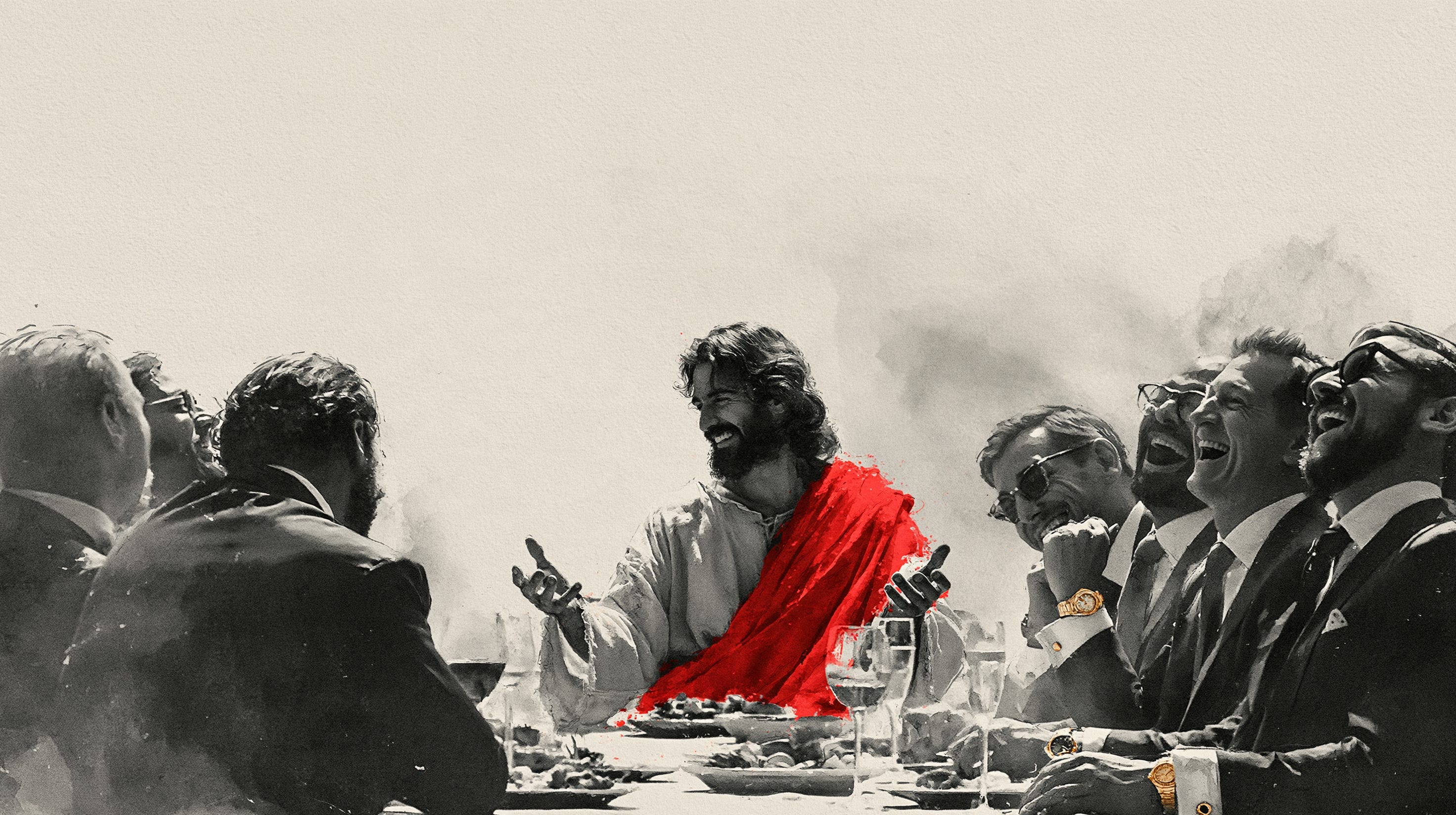
“He has gone in to be the guest of a man who is a sinner.”
—The grumbling crowd of Jericho (Luke 19:7)
The unwelcomed.
Picture a wealthy Christian, in tailored clothes—secure, comfortable, well regarded—kneeling on a hard floor with a basin and a towel, washing the feet of someone, particularly a ‘someone’ perceived by some to be at arm’s length from the church. Maybe someone formerly incarcerated, or an LGBTQ neighbor, or a woman who has had an abortion. Maybe someone living here without legal status. Someone who braces—or so we’ve heard—for whatever Christians might say next.
Most of us know what to do with that image. We recognize the Gospel in it. When someone of wealth and standing kneels to serve another, something of Jesus Christ is disclosed: the Lord who rose from supper, tied a towel around His waist, and washed the feet of His friends, who would all scatter before morning.1 It is power laid down in service to someone—particularly the someones we immediately recognize for the history of strained relationships, exclusion, or religious judgment—that makes the gesture of foot-washing meaningfully provocative.
Now turn the image around.
Jesus is walking through Jericho with a crowd pressing in on every side. He stops beneath a sycamore tree, looks up into its branches, and calls the richest and most resented man in town by name. Zacchaeus is a chief tax collector. He has built his fortune by working for an occupying empire and squeezing his own neighbors for more than they owed. Jesus says to him, “Zacchaeus, hurry and come down, for I must stay at your house today.”
I must. Luke uses that same small word of necessity when Jesus says the Son of Man must suffer. This visit isn’t a social whim. It belongs to the same divine necessity that is carrying Jesus to Jerusalem (by way of Jericho) and to the cross.2
And the crowd? “They all grumbled.” All of them.
Our selective recognition of grace.
We know what we’re supposed to feel with the first image: Jesus washing feet. But what do we feel—what do we do—with the second? What if the person Jesus chooses to honor in public is the wealthy exploiter? What if the one He seeks out is someone we don’t recognize as vulnerable at all, someone we identify with the very systems that make other people vulnerable victims?
We’re skilled at recognizing one scandal of grace while staying quietly uncomfortable about the other.
Jesus’ compassion for the poor, the sick, and the shut-out is unmistakable. He opens His ministry in Nazareth by announcing good news to the poor and liberty to the oppressed. He blesses the poor and pronounces woe on the rich.3
But the same Gospels show Jesus turning, again and again, toward people implicated in injustice, compromise, and religious self-righteousness. He calls Levi from a tax booth and goes to his banquet. He accepts dinner invitations from Pharisees who are watching Him closely, and he reclines at their tables. He sees a rich man about to walk away from Him, and Mark tells us, “Jesus, looking at him, loved him.” And among His twelve disciples are Matthew the tax collector, a collaborator with Rome, and Simon the Zealot, part of a militant resistance that sought to overthrow Rome—two men whose names evoke very different loyalties within a people living under Roman rule.4
Our theological imagination has been trained to find the first kind of mercy beautiful and the second suspect. When Jesus turns toward the beggar, we nod—we admire it, affirm it. When He invites Himself to the exploiter’s house, our mercy filter keeps us from noticing the scandal; if we do, something in us joins the crowd, or we find some kind of theological workaround.
So we have to ask: do we hold a narrow definition of acceptable compassion that, whether we realize it or not, sets a boundary for Christ’s reconciling love?
Our trouble is that we let the moral convictions of ‘my tribe,’ ‘my people,’ ‘my community’ decide where compassion ends and what it looks like, and we mistake their map for His. It’s why His compassion for the exploiter, the perpetrator, the heartless businessman, the crazy militant, and the political collaborator with the other party is… well… unnoticed.
To see what is at stake here, we have to set our principles down for a moment and watch what Jesus actually does.
The revelation of God in Christ.
Jesus stops for a beggar… and then invites Himself into a rich man’s house.
And the crowd objects both times—both times!5
The two encounters happen on the same road, a few verses apart, on Jesus’ final approach to Jerusalem.
As Jesus approaches Jericho, a blind man is sitting by the roadside, begging. He hears the crowd passing and asks what is happening. When he learns that Jesus of Nazareth is going by, he starts shouting: “Jesus, Son of David, have mercy on me!” Luke tells us exactly who tried to shut him up: “those who were in front.” That would mean the people closest to Jesus—leading the procession, setting its pace—decided this man was an interruption, a nuisance.
In response, he shouts even louder.
And Jesus stops.
He has the man brought to Him and asks, “What do you want me to do for you?” It is a question of startling respect. Jesus lets the beggar speak for himself. No assumptions are made. “Lord, let me recover my sight.” And he does. He follows Jesus, glorifying God, and the very crowd that tried to silence him ends up praising God too.
Then Jesus enters Jericho, and we meet Zacchaeus.
Luke does nothing to soften who he is: “He was a chief tax collector and was rich.” Zacchaeus is a wealthy collaborator with an occupying empire, running a lucrative operation that extracts money from his own people. He profits from the arrangement, and he lives comfortably on wealth gathered from the very people whose suffering he helps perpetuate. And he has made a fortune doing it. To his neighbors, he’s not merely rich. He is a traitor.
Too short to see over the crowd, he runs ahead and climbs a sycamore tree.
Jesus stops again.
He calls him by name. He invites Himself in. Zacchaeus comes down in a hurry and joyfully receives Him.
And then the grumbling: “He has gone in to be the guest of a man who is a sinner.”
These two situations are not morally interchangeable. One man suffers deprivation. The other profits from a compromised economic order. The same order that keeps the other man deprived. Jesus doesn’t romanticize the beggar’s poverty, and He doesn’t excuse exploitation. Yet He turns toward both.
Watch the crowd. On the road, it tries to silence the beggar. At the tax collector’s door, it grumbles at the Guest. In both cases, the crowd has already decided who this person is and what he is owed. And in both cases, the initiative of Jesus Christ interrupts the crowd’s verdict.
Luke has been preparing us for this encounter. Earlier, Jesus tells a parable “to some who trusted in themselves that they were righteous, and treated others with contempt.” A Pharisee stands and prays, “God, I thank you that I am not like other men… or even like this tax collector.” It is the tax collector, unable to lift his eyes and begging for mercy, who goes home justified.6 (We read that parable and, almost by reflex, thank God we are not like the Pharisee. Which is exactly the problem.)
Then Luke tells us about a rich ruler who asks Jesus what he must do to inherit eternal life. Jesus tells him to sell everything, give to the poor, and follow Him. The man becomes very sad, “for he was extremely rich.” Jesus doesn’t minimize the danger of wealth: “It is easier for a camel to go through the eye of a needle than for a rich person to enter the kingdom of God.” Those listening ask, “Then who can be saved?” And Jesus answers, “What is impossible with man is possible with God.”7
Now, only a few verses later, a wealthy chief tax collector climbs down from a tree and offers half his possessions to the poor, promising fourfold restitution wherever he has defrauded anyone. Luke shows us the impossible becoming possible, and it happens around a tax collector’s table.
And Jesus declares, “Today salvation has come to this house, since he also is a son of Abraham.”8 The crowd had called him a sinner. Jesus announces salvation and names him a son of Abraham.
The Jesus who stops for the blind beggar is the same Jesus who enters the tax collector’s home. Jesus’ compassion doesn’t erase the stark differences between their situations. Neither do those differences decide whether He will turn toward them. He turns toward both.
Why does Jesus act this way? Is He simply a man of unusually generous temperament, kinder than the rest of us? So maybe a little less judgmental? Or is something about God Himself being disclosed on the road through Jericho?
What Jesus does on that road, God is doing. There is no God behind the back of Jesus Christ.
Everything turns on who Jesus is.
If Jesus were only an exceptionally good man, His meals with sinners could be filed under personal generosity—admirable in its way, yet maybe an exception to some stricter divine policy (like the ones we hold and rationalize as divine). But the Church has confessed from the beginning that Jesus Christ is God the Son, of one being with the Father. It isn’t simply that Jesus is close to God, or sent by God, or like God. It means that the One standing at Zacchaeus’ door is God Himself, come in person. What Jesus does, God does. How Jesus welcomes, God welcomes. There is no other God hidden behind the back of Jesus Christ, a stricter God with a shorter guest list whom Jesus is quietly overruling.9
God in Christ! God in Christ on a road in Jericho! God in Christ at a tax collector’s table!
The welcome Zacchaeus received is not a lapse in divine decorum. It discloses exactly and perfectly who God eternally is.
Mercy goes to war.
And, shockingly, it goes way beyond this. The eternal Son took up for Himself our actual humanness in its fallen condition, entering our weakness, suffering, estrangement, and mortality. He took up all of it. Our hunger and our greed, our fear and our hostility, our grief and our guilt, our resistance to God and our contempt for one another. He went as deep as our humanness goes—yet without ever sinning—and He healed it all from the inside.10
There’s no edition of human nature that He took on that leaves out the tax collector. Or the crowd. Or the rich ruler. Or us. Yet no sin of ours, or the tax collector’s, or anybody else we might want to grumble about, is ever affirmed. He came to heal our humanity from within, not affirm our wrongdoing. His reconciling work inside of our humanity goes far beyond every line we’d ever draw between acceptable and unacceptable people.
God gave Himself freely and without reservation to all people, regardless of their righteousness, their wrongdoing, or their worthiness in our eyes. And whatever that is, it’s far more profound than simply saying “God loves everyone equally.” God gives Himself to everyone in love, without letting their moral character, social position, or even their response to Him determine whether they are worthy of that love.
God’s love does not distinguish between those we consider deserving and those we consider undeserving. He gives Himself freely to both. He doesn’t reserve His love for those whose suffering moves us or whose goodness earns our admiration. He gives Himself just as freely to those whose lives offend our moral sensibilities.11
His love is not indifference. He loves the wicked too much to abandon them to the wickedness that is destroying them. And He loves the wicked person’s neighbors too much to make peace with the suffering that same wickedness inflicts. His opposition to wickedness is not where His love ends. His opposition is what His love does when it encounters what is destroying those He loves. It’s an expression of His love. Divine love isn’t handed out as a reward to people who occupy acceptable positions. It flows from who God is: Father, Son, and Holy Spirit, giving Himself “while we were still sinners.” While we were enemies, we were reconciled.
The decisive question in the story of Zacchaeus is not what quality he must have possessed that qualified him for divine compassion. It is whether the incarnate Son had already turned toward humanity in the very estrangement from which Zacchaeus needs to be delivered.
And He has. That is what the Incarnation is.
And a love this wide mustn’t be mistaken for indifference to evil. The very same love that receives sinners judges sin. Holy love fights what is destroying the person it loves. Inside God’s mercy is judgment; apart from it, there is no real mercy.12
If God’s love reaches the exploiter, then hasn’t He gone soft on exploitation? If Jesus eats with the oppressor, what does that say to the oppressed? What kind of compassion is this…really? It’s exactly the kind of compassion a holy love would show when such love comes face to face with estrangement. It’s a love that overcomes it. Not by ignoring it. By judging it. Jesus meets our hostility by making it the supreme object of his compassion.13
Let that sink in.
Hostility itself became the object of His compassion. His mercy certainly reached our human weakness, our blindness, our hunger, our disease. But it also reached far beyond those. It also reached the interior reality of our resistance to the life that He gives—the only life there is. It reached the hardened heart, the grasping hand, the closed fist. He did far more than tend to people injured by evil. He gave Himself to overcome the evil that had taken hold of them. On the cross, He prayed for the men driving the nails: “Father, forgive them, for they know not what they do.”
God sets Himself against the darkness that has taken hold of us, and He does so for our sake and our sake alone. His “NO!” to sin serves His “YES!” to us.14 If we grasp what sin is, then we’d see that no greater expression of “YES!” exists than one that judges our sin. Sin isn’t harmless. And if we think it is—if we think it’s just those minor, pesky infractions of our lives—then none of this will make much sense. But if it is what turns us away from the source of life and back toward the nothingness from which we were created, then a God who sets Himself against that darkness is a God of great compassion. The cross shows us exactly how seriously God takes sin. “By sending his own Son in the likeness of sinful flesh and for sin, he condemned sin in the flesh.” His judgment on sin was aimed at our rescue.
And this is what frees us to hold together what our culture keeps pulling apart. We can love the exploiter and still name exploitation for exactly what it is. We can show compassion to someone implicated in injustice without shrinking the injustice by an inch. We can refuse to dehumanize a political opponent and keep opposing the harm of a political policy. We can forgive and still decline to hand back the keys.15 Accountability, rightly given, is itself a form of love. It refuses to leave a person inside the lie, inside the darkness.
Look again at the order of events in Jericho. Jesus’ initiative comes first. He calls, He invites Himself, He goes in—before a word of repentance is ever spoken, before a single coin is returned. And then Zacchaeus stands up: “Behold, Lord, the half of my goods I give to the poor. And if I have defrauded anyone of anything, I restore it fourfold.” Christ’s presence at his table didn’t leave his relationship to his money untouched. It turned it inside out. The movement runs from grace toward repentance. Repentance is what happens to a man once Jesus has come through his door.
Christ’s love doesn’t make peace with the evil that has captured a human being. It makes war on that evil, for the sake of the human being God loves.
If this is how God meets us in Jesus Christ, then we have to ask whether our own ways of seeing let us recognize the actual person in front of us, or keep us from recognizing them.
How we reduce persons.
Our selective compassion starts earlier than we think. Long before we decide to withhold our love from someone, we’ve already decided who they are.16
To know something truthfully, we must let the reality of that something correct the ideas we bring to it. Otherwise, we end up forcing what we encounter into a picture we’ve already made. In the end, we won’t actually know anything true about the reality before us; we’d only think we do. Our concepts must always remain answerable to the truth of the reality before us. They must be held loosely. This is as true of how we encounter other people as it is of scientific inquiry. We treat others according to what is true, not according to what we have already decided is true about them. And that attentiveness to what is actually true is part of genuine personal love.
However, we rarely encounter people without descriptions already in hand. Wealthy. Poor. Oppressed. Oppressor. Conservative. Progressive. Pastor. Church dropout. Divorced. Addict. Successful. Failure. The person who wronged us. The person everyone admires. Some of these descriptions are accurate, even morally important. But none tells us the whole truth about a human being.
But descriptions have a way of becoming more than descriptions. They harden into controlling abstractions, frames through which we decide in advance who another person must be. And the real person disappears behind the abstraction.
Christ does not encounter an abstraction called ‘the exploiter.’ He encounters Zacchaeus, who really is implicated in exploitation but whose humanity is not exhausted by that truth.
This same thing happens in business, where we meet a ‘user’ or a ‘market’ long before we ever meet Sarah. We do it with our neighbors: We meet a ‘progressive’ or a ‘MAGA voter’ long before we meet the actual person. We do it with a new acquaintance: we meet an Enneagram 8 or an INTJ before we meet a friend. We do it in ministry, too. We meet the ‘God-and-Country Believers’, the ‘Spiritual But Not Religious’, the ‘Religiously Unaffiliated’, the ‘Spiritually Curious’, before we meet a person with a name, a history, and a grief we know nothing about.
We do need to tell the truth about exploitation, including the responsibility of those who perpetrate it. But even the truth about what someone has done is not the whole truth about who they are. Neither is political allegiance, religious reputation, social standing, nor personal history. These do not give us license to assume we’ve fully understood another person’s motives, history, struggles, or possibilities.
Paul saw this clearly. “Because One has died for all,” he says, “from now on, therefore, we regard no one according to the flesh.”17 The cross took away his right to size people up by the world’s measures. When our categories decide in advance what we’re permitted to see in another person, we are no longer attending to the person before us. We are attending to an abstraction of our own making.
None of this means we abandon moral judgment. Exploitation is real. So is oppression. Love requires us to name these evils truthfully and to oppose the harm they cause. But even a truthful judgment about someone’s wrongdoing cannot tell us the whole truth about that person. When our judgments become definitions of who someone is, they stop serving the truth and start concealing it.
This is what makes the encounter with Zacchaeus so significant. Jesus doesn’t set aside the truth about Zacchaeus’s wrongdoing. But He also doesn’t let that wrongdoing determine the character or extent of His reconciling approach to him.
Compassion in bondage.
Unfortunately, our abstractions are rarely private, personal mistakes. The communities we belong to, and whose approval we want, reinforce them every day. Our tribe can quietly become the judge of our love. It’s just safer to be seen loving the right people.
Every community develops unwritten judgments about who deserves solidarity, whose suffering deserves attention, and whose wrongdoing is disqualifying. Such judgments may recognize genuine suffering and wrongdoing. But recognizing what someone has done is not the same as knowing who that person is, much less what Christ’s love requires toward them.
The danger comes when those judgments begin to govern our own participation in Christ’s love. Then, often without our noticing, the question shifts. Instead of asking what faithfulness to Christ requires, we ask what response will preserve our standing among our own people. Compassion acquires a vetting process. We run the background check before we run toward the person.
Yet the problem runs deeper than social pressure. Our moral judgments are not merely incomplete because we lack sufficient biographical information. They are incomplete because the deepest truth about a human being is not constituted by their moral achievements, failures, social identity, or reputation, but is disclosed in the incarnate and reconciling Son.
That is why the crowd in Jericho could be right about Zacchaeus’s wrongdoing and profoundly wrong about what Jesus should do with him.
And so we can reproduce the very exclusions we condemn. Some of us denounce what we see as the stereotyping of immigrants or gay neighbors, and then caricature the evangelical uncle, the wealthy executive, or the neighbor in the red hat without a second thought. Others of us denounce what we perceive as contempt for believers or for unborn life, and then give no thought to dismissing the progressive Christian, the abortion-rights advocate, or the neighbor who no longer shares our faith.
I’m not suggesting that the moral questions involved are all the same, or that every political disagreement, moral judgment, or form of exclusion is equally consequential. What concerns me is how easily we let our judgments about people determine how much of their humanity we’re willing to see. Even legitimate moral convictions can become occasions to withhold compassion and draw back from participation in Christ’s reconciling love.
And we are remarkably quick to believe that the other tribe does this worse than our own. It is the Pharisee’s prayer with updated vocabulary: God, I thank You that I am not like those people.
This calls for some precision. The Church is not called to overlook wrongdoing in the name of love. Paul instructed the Corinthians to remove from their fellowship a man whose serious sin they had tolerated.18 Elsewhere, he tells believers to distance themselves from a disobedient member, but adds, “Do not regard him as an enemy, but warn him as a brother.”19 And he calls for those caught in wrongdoing to be restored in a spirit of gentleness.20 The Church may need to rebuke, discipline, or even remove someone from its fellowship. It may need to protect those who have been harmed and require repentance and accountability before trust can be restored. But Christ’s love need not be withdrawn when trust, access, or fellowship is limited. Indeed, love may require those limits. Faithfully exercised, discipline is one way that love refuses to make peace with what harms people and undermines the Church’s witness.
But the Church’s responsibility to exercise discipline does not give it the final word about anyone’s standing before God. The Church does not establish its own standards of holiness any more than it originates reconciliation; both are grounded in Jesus Christ. The problem is not that a Christian community makes consequential judgments. It must. The problem arises when those judgments stop serving Christ and start protecting the community’s sense of its own righteousness. We confess Christ as the one Mediator in our creeds and sing of Him in our songs. Yet a community’s approval can still function as a rival authority when its standards of acceptance begin to determine whose humanity we’re willing to recognize and whom we’re prepared to love. We confess one Mediator on Sunday and consult another on Monday.21
There’s a distinction that gets at what this is. A covenant begins with a freely given promise: “You shall be my people, and I will be your God.”22 The obligations that follow flow from that freely given promise. But a contract begins with conditions: if you do this, then I will do that. God relates to us by covenant. And the covenant of grace does not abolish our obligations to one another; it establishes them. But when a Christian community begins to function as a tribe, its relationships can take on the character of contracts. Acceptance comes with terms and conditions, and we learn quickly which kinds of compassion void the warranty.
So it is worth asking directly: What does it reveal about our trust in the reconciling work of Jesus Christ when we are more afraid of being seen loving the wrong person than of failing to share in Christ’s love for that person? It reveals where we are looking for our righteousness. We say we are justified by grace. But our working sense of being in the right—of being the good guys, of being safe, of being among the people who get it—comes from our tribe’s approval. And approval like that has to be earned, guarded, and constantly renewed.
This is precisely the bondage that God’s grace breaks. Unconditional grace cuts deep into us and frees our soul from its entrenched bondage to the self.23
Here is why it can. Jesus Christ did more than die in our place. He lived in our place. From inside our humanity, He offered the Father the faith, obedience, prayer, and worship we owed and could not give. Jesus is our human response to God, offered perfectly on our behalf, and by the Holy Spirit we are given a share in it. Paul puts it in the first person: “It is no longer I who live, but Christ who lives in me.”24
If my standing before God rests, then, on His faithfulness instead of my performance, I no longer have to secure my identity through the moral approval of my group. I am free to love someone my community mistrusts. I am also free to challenge my community where its judgments contradict Christ’s reconciliation. Both freedoms come from the same place.
The irony is deeper than Christians who proclaim unconditional grace sometimes practicing conditional love. People set free by the grace of Jesus Christ remain enslaved to the approval of those who decide which expressions of that grace are socially acceptable.25
Christian freedom is more than freedom from our communities’ verdicts, though. It is freedom for something: a share in what Christ is already doing.
Participating in the ministry of Christ.
The Church does not originate reconciliation. Nor does it stand outside Christ’s reconciling work, deciding which persons should be given access to it. Its whole life is participation, by the Holy Spirit, in the incarnate, crucified, risen, and ascended Lord, who “always lives to make intercession” for His people.26 He is still the minister. And our ministry is a sharing in His. And that means sharing not only in His welcome, but also in the truth-telling, correction, and patient work of restoration that belong to His reconciling love.
Here’s how Paul describes it: “All this is from God, who through Christ reconciled us to himself and gave us the ministry of reconciliation; that is, in Christ God was reconciling the world to himself, not counting their trespasses against them, and entrusting to us the message of reconciliation.”27
All this is from God. The ministry is given. The message is entrusted. And the scope is the world.
The Church’s whole vocation can be put into a single sentence: “The Church must proclaim the reconciliation by which it lives and live out the reconciliation it proclaims.”28 A church that announces reconciliation to the world but lets social respectability, tribal loyalty, or moral superiority determine whom it welcomes in Christ’s name contradicts itself in public. Jesus Christ secures its identity. It needs no enemy category to know who it is.
On the evening of the resurrection, the risen Jesus stands among frightened disciples behind locked doors and says, “As the Father has sent me, even so I am sending you.” Then He breathes on them: “Receive the Holy Spirit.”29 The Spirit draws the Church out of its self-preoccupation and into the mission of its Lord. This is far more than imitating Jesus’ moral example from a distance. It is sharing in His living ministry as the one Mediator.
So Christian hospitality starts with a different question. “Does my community approve of this person?” gives way to “What might faithful participation in Christ’s love, truth, and reconciliation ask of me toward this person?” We won’t always know everything Christ is doing in another person’s life. We remain dependent on the Spirit for discernment, and that dependence is itself part of our freedom.
Here is the heart of it. The Church doesn’t decide whom Christ is permitted to love. Instead, it is called to share in the love by which Christ has already turned toward the world.
By what authority, then, have we allowed our communities to set the boundaries of a love whose source, content, and reach have already been established in Jesus Christ?
That love will take different shapes for different people. For the poor Christian, it may mean hospitality toward a wealthy person who has profited from others’ hardship. For the wealthy Christian, it may mean using their wealth and influence to serve people who have been neglected or treated unjustly. For the activist, it may mean compassion toward someone who serves the very system they are fighting. For the Christian whose community regards certain neighbors with suspicion, it may mean extending friendship and care rather than keeping them at a distance. In every case, love stays truthful, and it stays just.
Our freedom rests on something older than any of our criteria. Jesus Christ acted toward humanity before any criteria could lay a claim on Him. He was at Zacchaeus’ door before the crowd had finished grumbling.
Freedom like this becomes real witness only when it takes concrete form, in the actual needs, harms, and relationships of human life.
Love gives each person what the truth of their situation requires.
Love that’s unconditional, not indifferent.
Christ’s love is unconditional, but it is never indifferent to wrongdoing.
God loves both the exploited and the exploiter. They do not stand in equivalent moral positions. The exploiter may need rebuke, repentance, accountability, and restitution. The exploited may need protection, provision, advocacy, healing, and justice. Christ’s love reaches both, though rarely in the same way. A doctor who loves two patients doesn’t give them the same prescription.
The Christian who loves Zacchaeus has to care about the neighbors Zacchaeus defrauded. Jesus’ welcome did. The first fruit of that dinner was money flowing back to the people who had been robbed.
Love, justice, and freedom are held together. Repentance is the necessary response to forgiveness, not its precondition, and real reconciliation may require reparation. That is the light in which to see Zacchaeus. Christ’s hospitality was not conditioned on Zacchaeus first repairing the damage. But the encounter can’t be separated from the restitution that followed. Forgiveness is a gift grounded in the cross. Restored trust is rebuilt over time, as truth is told and harm is repaired.
So hospitality requires discernment. It does not mean placing vulnerable people in harm’s way, trusting an unrepentant abuser, or declining to oppose an unjust institution. Love may involve confrontation, resistance, institutional accountability, and protective boundaries. Love may require them. And the work of protection belongs to the whole community, so that those who have been harmed are never left to face the one who harmed them alone.
What changes is this: even in our resistance to wrongdoing, we need not reduce the wrongdoer to an object of contempt.30
We are told constantly that we must choose between loving the oppressed and loving the oppressor. The real question is whether our love is grounded deeply enough in Jesus Christ to seek justice for the oppressed without surrendering the humanity of the oppressor to our contempt.
Let’s return to the two scenes. A Christian kneels to wash the feet of someone perceived to be on the margins of the church. Jesus goes in to be the guest of a tax collector whose wealth is tangled up in exploitation.
The question is no longer which scene better represents the Gospel. Both confront us with the freedom of divine grace, each in its own way. The love of Christ will not be constrained by our judgments about which kinds of mercy are socially impressive, morally respectable, or politically safe. The Son who became flesh for our reconciliation has already taken the initiative. The Holy Spirit draws the Church into that same reconciling movement.
This is our freedom: to tell the truth about evil without abandoning the human being, and to answer Christ faithfully without being governed by the approval of our own people.
Listen one more time to the crowd’s complaint: “He has gone in to be the guest of a man who is a sinner.” They meant it as an accusation. Luke wrote it as good news. Every one of us has stood in that crowd. And every one of us has been the man in the tree.31
Jesus stopped for the blind beggar. He went in to the wealthy tax collector. In both encounters, it was Jesus, and not the crowd, who decided the meaning and direction of His reconciling presence. He still does.
He has already gone in.
Are we free enough in Christ to follow Him, and to love someone our own people might condemn us for loving?
The Lord who washes feet. John 13:3–5; Mark 14:50. John explicitly connects Jesus’ knowledge that the Father had given all things into His hands with His act of washing the disciples’ feet. His service arises from the freedom of His divine authority, not its absence.
The necessity of Jesus’ visit. Luke 19:5; 9:22; 24:26. The language of necessity connects Jesus’ visit with Zacchaeus to the wider divine purpose unfolding in Luke’s Gospel. It locates both this visit and the passion within His saving mission.
Christ’s compassion for the poor. Luke 4:18–19; 6:20, 24. Jesus announces good news to the poor and liberty to the oppressed, then pronounces both blessing and warning in His teaching. His compassion for those who suffer cannot be separated from His concern for justice.
The morally and religiously unexpected disciples. Matthew 10:3–4; Luke 6:15. The apostolic lists name Matthew the tax collector, and Simon called the Zealot. See also Luke 5:27–32 on Levi’s calling and banquet, and Mark 10:21 on Jesus’ love for the rich man.
The crowd objects twice. Luke 18:35–43; 19:1–10. Luke narrates the encounters consecutively. Those leading the procession rebuke the blind beggar, while the crowd later grumbles when Jesus enters Zacchaeus’s house. Both responses are overcome by Jesus’ initiative.
The Pharisee and the tax collector. Luke 18:9–14. Jesus addresses this parable to those who trust in their own righteousness and regard others with contempt. The decisive contrast is between self-confidence and dependence on God’s mercy.
The impossibility of salvation. Luke 18:18–27. The rich ruler’s encounter precedes those of the blind beggar and Zacchaeus. Jesus’ declaration concerning God’s power prepares the reader for the surprising response of another wealthy man in Luke 19.
Salvation comes to Zacchaeus’s house. Luke 19:8–10. Zacchaeus declares that he gives half his goods to the poor and restores fourfold wherever he has defrauded anyone. His declaration and Jesus’ announcement of salvation stand together in the narrative. The present-tense Greek verbs in verse 8 have been interpreted either as new commitments or as descriptions of existing practice; the former reading fits the narrative movement adopted here, though the grammatical question is disputed.
Jesus Christ reveals the Father; He does not overcome the Father’s reluctance to love (there’s no such thing). “Whoever has seen me has seen the Father.” —John 14:9. Jesus explains that His words and works arise from His communion with the Father (John 14:10; 5:19). Paul likewise declares that “in Christ God was reconciling the world to himself” (2 Corinthians 5:19). The Father is therefore not a distant deity whose opposition must be overcome by a more compassionate Son. Nor does Jesus reveal a mercy unrelated to divine holiness. The saving action of Jesus Christ is God’s own action. His welcome of sinners discloses the Father’s reconciling purpose, while His judgment of sin expresses the same holy love. We mustn’t divide God’s character by setting Christ’s mercy against the Father’s will.
Christ assumes our humanity without sinning. Hebrews 2:14–17; 4:15; Romans 8:3. The Son truly shares our human condition, yet remains without sin. His assumption of our fallen humanity must not be confused with personal participation in sinful acts or dispositions. The purpose of His solidarity is our deliverance and sanctification.
God’s love is not conditioned upon our moral worthiness. Jesus points to the Father, who “makes his sun rise on the evil and on the good, and sends rain on the just and on the unjust”—Matthew 5:45. Paul takes us further: “While we were still sinners, Christ died for us,” and “while we were enemies we were reconciled to God by the death of his Son”—Romans 5:8–10. The Father’s goodness is not confined to those who deserve our approval, and His reconciling initiative in Christ reaches us in our estrangement, before our repentance or obedience could establish any claim upon His love. God’s love originates in who He is, not in the moral qualities of those He loves.
Grace delivers us from sin’s dominion, not merely its penalty. “The grace of God has appeared, bringing salvation for all people, training us to renounce ungodliness.” —Titus 2:11–12. Grace includes God’s transforming action against the evil that enslaves us. Romans 8:3–4 similarly connects God’s condemnation of sin in Christ with life in the Spirit. Divine mercy is therefore not indifference to what destroys human life.
Christ’s reconciling love reaches us even in our hostility toward Him. “While we were enemies, we were reconciled to God by the death of his Son.” —Romans 5:10. Reconciliation is God’s initiative toward us while we are still estranged from Him, not a reward for having first overcome our hostility. At the cross, Jesus prays for the forgiveness of those responsible for His execution (Luke 23:34). His prayer is offered in the midst of their violence, not after their repentance. Neither passage excuses human hostility. Together they reveal a mercy that confronts and overcomes our opposition to God rather than allowing that opposition to place us beyond His reconciling love. This expression of Christ’s compassion is adapted from Thomas F. Torrance, Gospel, Church and Ministry, ed. Jock Stein (Eugene, OR: Pickwick Publications, 2012), 153: “Jesus met the hostility of man by making it the supreme object of his compassion.”
God’s “No!” to sin serves His “Yes!” to humanity. Romans 8:3–4; 2 Corinthians 5:21. God's condemnation of sin in Christ belongs to His purpose of freeing humanity from sin’s dominion and restoring life in the Spirit. The opposition to sin serves reconciliation rather than contradicting it.
Forgiveness and restored access are not the same thing. “If your brother sins, rebuke him, and if he repents, forgive him.” —Luke 17:3. Jesus joins forgiveness to truthful confrontation rather than treating the two as opposites. Matthew 18:15–17 establishes accountability within the believing community, while 2 Corinthians 2:6–8 calls for forgiveness and reaffirmed love following sufficient discipline. Scripture thus distinguishes the obligation to forgive from the processes for addressing damaged relationships. Forgiveness does not automatically establish that trust has been restored, responsibilities may be resumed, or renewed access is safe. Those matters require careful discernment and sometimes continued protective boundaries.
Partiality is a failure of judgment before it becomes a failure of conduct. “Do not judge by appearances, but judge with right judgment.” —John 7:24. James 2:1–4 makes the danger concrete: a congregation honors the wealthy visitor while humiliating the poor one, letting outward circumstances govern how it treats people. Scripture does not forbid discernment; it forbids partiality and judgment governed by appearances. First Samuel 16:7 reminds us that human beings see outwardly while the Lord sees the heart. We therefore ought not to confuse what we can legitimately observe about someone with exhaustive knowledge of who that person is.
Knowing no one according to the flesh. 2 Corinthians 5:14–16. Paul’s transformed way of regarding others is grounded in Christ’s death for all. It is not merely a general warning against prejudice, but belongs to his account of reconciliation and new creation (2 Corinthians 5:17–19).
Paul’s instruction to remove an unrepentant member. 1 Corinthians 5:1–5, 11–13. Paul directs the congregation to confront serious wrongdoing within its fellowship. His instructions concern the community’s integrity and the ultimate good of the person being disciplined, not a declaration that the person lies beyond God’s mercy.
Discipline without enmity. 2 Thessalonians 3:14–15. Paul instructs the congregation to take disciplinary action toward a persistently disobedient member while expressly forbidding them to treat that person as an enemy. Correction does not erase the continuing obligation of brotherly love.
Restoration with gentleness. Galatians 6:1. Paul commands restoration in gentleness and adds that those undertaking correction must watch themselves lest they also be tempted. The exercise of discipline must therefore be accompanied by humility about one’s own vulnerability to sin.
The Church exercises authority under Christ, never in His place. “For there is one God, and there is one mediator between God and men, the man Christ Jesus.” —1 Timothy 2:5. The uniqueness of Christ’s mediation does not abolish the Church’s authority to teach, correct, or exercise discipline (Matthew 18:15–18). It establishes the source and limits of that authority. Paul’s question in Galatians 1:10—whether he seeks human approval or serves Christ—exposes the danger when pleasing others becomes the deciding factor. The Church’s judgments must serve the Lord it confesses; neither its approval nor its disapproval can establish a person’s righteousness before God.
Covenant and contract. Jeremiah 30:22. See also James B. Torrance, Worship, Community and the Triune God of Grace (Downers Grove, IL: InterVarsity Press, 1996), on the distinction between covenant and contract. In the covenant of grace, God’s promise and initiative precede the obligations of human response; those obligations arise within the relationship God establishes.
Unconditional grace and freedom from the self. Paraphrased from Thomas F. Torrance, “Thomas Torrance Responds,” in The Promise of Trinitarian Theology: Theologians in Dialogue with T. F. Torrance, ed. Elmer M. Colyer (Lanham, MD: Rowman & Littlefield, 2001), 323. In response to Ray S. Anderson, Torrance describes how unconditional grace penetrates and liberates human beings from bondage to the self.
Christ lives our faithful response to the Father. Galatians 2:20; Romans 5:19; Hebrews 5:8–9. Paul’s account of life in Christ is inseparable from Christ’s faithful obedience on our behalf. The believer’s life is grounded in the Son’s obedience and self-giving, not in human righteousness achieved independently.
Christian freedom must not be exchanged for another dependence. “For freedom Christ has set us free; stand firm therefore, and do not submit again to a yoke of slavery.” —Galatians 5:1. Paul addresses dependence upon the law as a basis of justification, not modern political or religious tribalism. Nevertheless, his warning establishes a broader theological principle: the believer must seek security and righteousness only in Christ. Applying that principle to communal approval is a pastoral inference from Paul’s argument, not its original subject.
Christ’s priestly ministry has not ended. “He is able to save to the uttermost those who draw near to God through him, since he always lives to make intercession for them.” —Hebrews 7:25. The ascended Jesus Christ remains our living High Priest. His reconciling ministry is not merely something He accomplished in the past and then handed over to the Church. He continues to intercede for those who approach the Father through Him. The Church therefore serves under a living and active Lord, not in the absence of one.
The Church is entrusted with the ministry of reconciliation. 2 Corinthians 5:18–20. Paul grounds both the accomplishment of reconciliation and the Church’s ministry of reconciliation in God’s prior action through Christ.
Thomas F. Torrance, “The Mission of the Church,” Scottish Journal of Theology 19, no. 2 (June 1966): 141.
The risen Christ sends the Church in the Spirit. John 20:19–22. The risen Christ commissions His disciples in relation to His own sending by the Father, then breathes upon them and commands them to receive the Holy Spirit. Their mission is thus grounded in His prior mission and enabled by the Spirit.
Christian correction seeks repentance, not humiliation. “Correcting his opponents with gentleness. God may perhaps grant them repentance leading to a knowledge of the truth.” —2 Timothy 2:25. Paul requires patience and gentleness even in the presence of opposition, because repentance is ultimately God’s gift, not something we can produce through contempt. Galatians 6:1 likewise calls for restoration in gentleness and warns the one correcting another to watch himself. Neither passage prohibits rebuke or serious accountability. Rather, both place correction under the purpose of restoration and require humility from those exercising it.
Shared need for grace does not make every wrongdoing morally equivalent. “For all have sinned and fall short of the glory of God.” —Romans 3:23. Paul’s declaration establishes the universality of human need before God, not the equivalence of every human action or its consequences. The Pharisee and the tax collector in Luke 18:9–14 occupy different positions in the story, yet the decisive question concerns dependence upon divine mercy rather than confidence in oneself. Likewise, Zacchaeus’s particular responsibility cannot simply be transferred to everyone else. We share his need for Christ’s saving initiative without necessarily sharing the particular harms for which he must answer.