

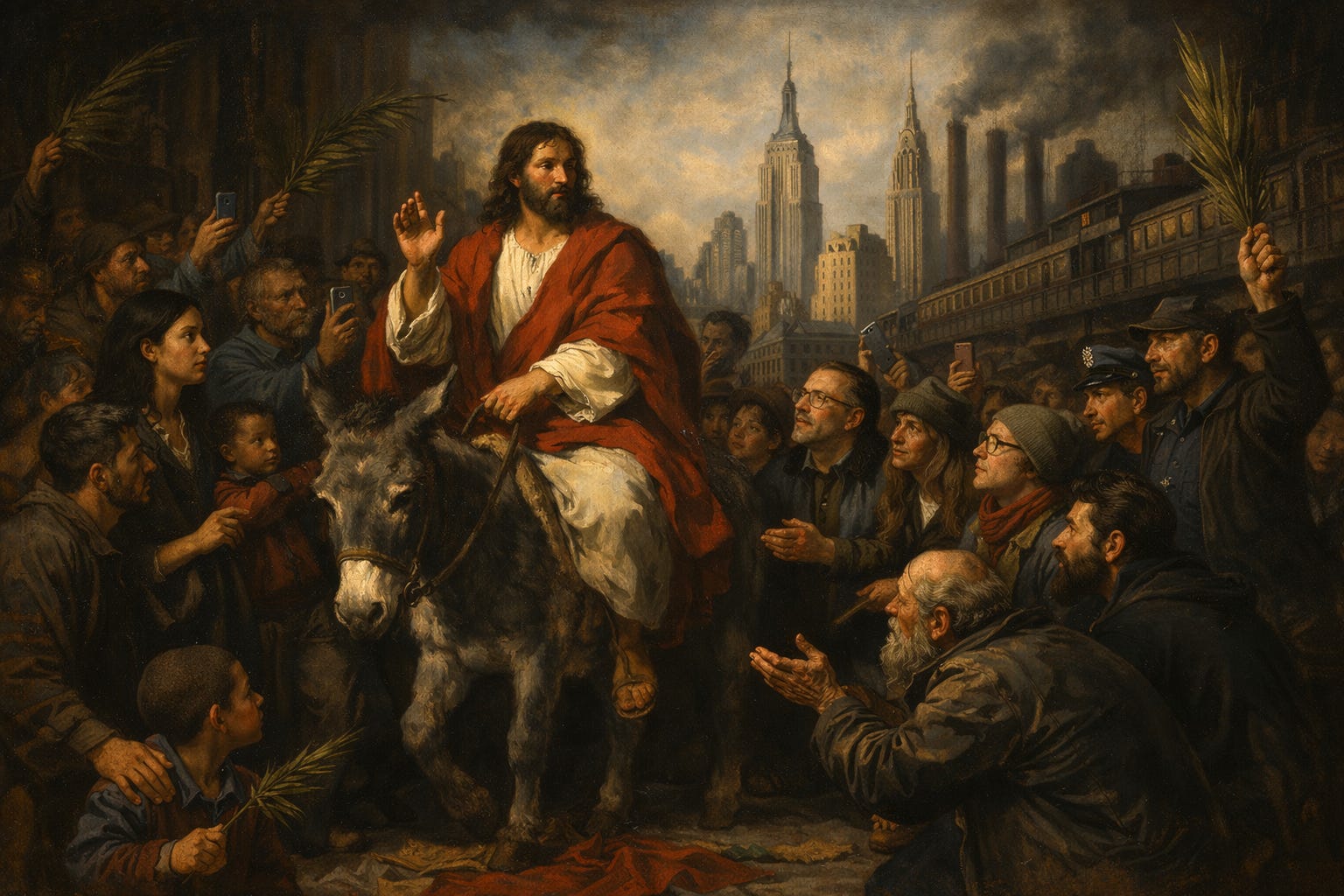
Palm Sunday isn’t a sentimental prelude to the “real” saving work of the cross. If we look closely, we’ll see that Palm Sunday reveals the very logic of God’s reconciliation.
Jesus Christ enters Jerusalem on Palm Sunday because the triune God does not remain at a safe distance when he saves us. He is not a distant sovereign, untouched by our pain, our humanity. He is the incarnate Son, stepping into the epicenter of our estrangement, our violence, our religion, our grief, our death. He descends into the marrow of our brokenness. In Christ, God’s nearness is not a metaphor. It is the structure of reality itself.
We tend to think of God’s revelation and of the atoning work of Christ as two very different things. One is secret knowledge of, say, a future event we’d otherwise know nothing about, and the other concerns the work of the cross. But they are a single, indivisible reality—so interwoven that to separate them is to lose both. In Christ, revelation and atonement are one movement of God’s self-giving.
Revelation and atonement go hand in hand. They are not two acts, but one. Revelation isn’t God letting us in on his secret moves. Revelation is self-revelation—God unveiling himself, giving himself, making himself known to us. And this he did perfectly and completely and embodied in Jesus Christ. What Christ does, as an act of God’s self-revelation, is the work of atonement. The atoning work of Christ is the self-revelation of God. The self-revelation of God is the atoning work of Christ.
So who Christ is — who God reveals himself to be in Christ — and what Christ does, cannot be severed. They are one and the same. The identity of Jesus and the action of Jesus are one. In other words, there is no hidden god lurking behind the back of Jesus. And there is no god other than the one revealed in the flesh-and-blood actions of Christ, in his atoning work, in his self-giving love.
Atonement does not begin at the cross, but in the hiddenness of Mary’s womb. There, atonement was already underway. The cross was not a new, stand-alone act in the life of Jesus. It was the radiant intensification of the same love that had pulsed through every moment of his life. In Jesus, God’s self-giving is not one event among others. It is all the events. It is the unveiling of the very heart of God’s royal “Yes!” in Christ, resounding louder than every human “No!”
Palm Sunday reminds us that divine majesty is not found in spectacle. It is revealed in humility, in obedience, in self-giving love that overturns every worldly expectation.
Here, the logic of the Kingdom stands unveiled. And we are summoned to follow.
And the Word became flesh and dwelt among us, and we have seen His glory…
— John 1:14.
God does not save from a safe distance, but comes near in the incarnate Son. Revelation and reconciliation in one movement. God’s glory is not elsewhere than in the enfleshed life of Jesus. Palm Sunday is not decorative pageantry but the visible form of divine nearness.

…in Christ God was reconciling the world to Himself…
— 2 Corinthians 5:19.
God himself is at work in Christ, and the work is reconciliation. There is no distant deity standing behind Jesus while Jesus does something merely external on God’s behalf. The reconciling act is God’s own act, and it happens in Christ.

For in Him all the fullness of God was pleased to dwell, and through Him to reconcile to Himself all things…
— Colossians 1:19–20.
Incarnation ( all the fullness… dwell ) is joined together with atonement and reconciliation ( through him to reconcile ). Palm Sunday is cosmic. Christ’s entry into Jerusalem is not a local religious event, but part of the divine act by which all things are gathered back to God.

He is the radiance of the glory of God and the exact imprint of His nature…
— Hebrews 1:3.
Christ is the exact imprint of God’s being; who God is and what God does are disclosed in Him.

...He humbled Himself… becoming obedient to the point of death, even death on a cross.
— Philippians 2:6–8.
Divine majesty is revealed in humility, obedience, and self-giving love. The triumphal entry is the movement of the obedient Son toward the cross. The kingship on display is not spectacle, but humble lordship.

Behold, your King is coming to you; righteous and having salvation is He, humble and mounted on a donkey…
— Zechariah 9:9.
The king comes in humility, yet he comes as the bearer of salvation.
This spiritual antipasto has an accompanying call to worship:
