

Have you not read what was said to you by God: ‘I am the God of Abraham, and the God of Isaac, and the God of Jacob’? He is not God of the dead, but of the living. — Jesus.
The God of that Jacob.
A theology of grip.
There is a kind of God that we would invent. He’d be a respectable God. A safe God. A God who blesses people who improve. A God who keeps His distance from the complicated ones, just as we do. A God who stands for the cleaned-up, the stable, the socially presentable, the spiritually functional.
We don’t quite say any of that out loud. We don’t think we think such things. But then we read the Old Testament and find ourselves baffled, and we say, “I don’t get it! The people God chose? The things those people did? What? Really?”
But that’s the God that Jesus named—the God of Abraham, the God of Isaac, the God of Jacob.
Jesus never said, “God is the God of the strong.” Or the “generally better than most.” Or the “not surprisingly horrible.” Or “those somewhat like me.” He said, “God is the God of Abraham, the God of Isaac, the God of Jacob.” It wasn’t a three-part history lesson. When He said that, He was taking apart a worldview.
If God is the God of Abraham, Isaac, and Jacob, then He is the kind of God who binds Himself to the unimpressive, the untidy, the inconsistent, and the unsafe.
And Jacob?
Jacob is no role model. He is deceiving, selfish, relationship-destroying, dysfunctional, and driven by ambition. He schemes, he grasps, convinced that blessing must be snatched by being cunning. He fractures his family. He destabilizes everything around him. He leaves a trail of collateral damage.
Scripture does nothing to sanitize him. Doesn’t try to clean him up. It leaves Jacob raw and real for two reasons: Jacob is a mirror. And God is the God of Jacob.
Jacob’s story is a story of mercy and truth. It tells the truth about God, and it tells the truth about us. God’s covenant love story weaves right through generations of dysfunction and stubborn self-will. And that is a good thing, because that’s our address, too. There is a patient, relentless cleansing work that God does over time. He did it with Jacob, and He does it with us. Jacob kept breaking himself, and yet by grace, he became a blessing to the nations.
So when Jesus calls God the God of Jacob, He is making a mind-blowing claim about what kind of God God is. He is defined by His relentless grip on the unworthy. He is the God who binds Himself to broken people and will not let go.
The God of the living.
Death cannot terminate His faithfulness.
He is the God of the living, not the dead.
This truth is serious, and it is also comforting. It means God’s faithfulness is unrelenting. Even death cannot end it. Death does not get the last word over God’s promises. It means God is not “done with them yet.” Not with Abraham. Not with Isaac. Not with Jacob. Not with anyone you’ve buried. Not with you.
If God is the God of the living, then we never slip from His grasp—not when our hearts stop, and not in all the smaller deaths along the way: the collapses, the betrayals, the relapses, the shame spirals, the seasons where you can’t pray without feeling like a fraud. Even in death, or in anything that leads us toward it, we never cease to be the object of God’s love.
Grace is not a “thing.”
It is the invariable grip.
Grace is not a mood that God has on occasion. Grace is not a feeling He experiences toward us (and we’re kind of glad it’s most of the time). It’s not an attribute sitting inside God like a tool on a shelf that He will grab from time to time. It is not a leniency toward our mistakes. It is not a spiritual commodity that He happens to have in abundance.
No.
Instead, grace goes deeper: it is personal action—deeply personal action. Grace is God giving Himself to us unreservedly. Grace is not a “what.” Grace is a “who.” And the name of that “who” is Jesus Christ.
That sounds like a wild, abstract theological idea. But it’s as simple as it is true. It is the basic architecture of Christian reality. If grace were something God handed out, then grace could be detached from God’s own being, and we could imagine it rationed, withdrawn, negotiated, earned, triggered, or revoked.
But grace is God giving God—Father, Son, and Holy Spirit. It is rooted in God’s eternal, triune being.
Thank goodness grace does not depend on us. Our grip slips and fluctuates and falters. Sometimes we cling. Sometimes we loosen. Sometimes we forget. Sometimes we drift. Sometimes we actively shove Him away in rebellion. Our grip is not “invariable.” It is unstable.
But—God’s grip is the One Invariable Grip.
And that is why He is the God of Jacob. That is why salvation is not grounded in the strength of our faith, or our character, or our life. Our salvation does not depend on the unyielding strength of our hold on God, but on the unyielding strength of God’s hold on us.
This is why His grace is fierce.
Yet we’d prefer His grace not to be so fierce. We’d like it to be more like a gentle permission for who knows what we’re allowing into our lives. God’s grace is gentle, but it is not permission for self-destruction.
Grace is God’s fierce, unconditional, unyielding movement into the deepest, darkest corners of our rebellion, into the most shameful and broken parts of our being, into the parts nobody will ever know about—so that our story will never read like Jacob’s—so that He can heal us there and bind Himself to us there, in those very parts and places, and do so forever. FOREVER!
Which means grace is not God tolerating our ruin. It is God refusing to abandon us to it. What we call “wrath” is often just the consuming fire of divine love refusing to make peace with the things that are slow-walking us away from communion with Him—which means away from Life itself—and, therefore, into nonexistence.
That is what it looks like when God loves for real. Because God truly loves us, He doesn’t do the “safe distance” thing. Grace is not God watching us self-destruct from a safe distance.
We are not people who have just made a few mistakes, needing just a little bit of grace to keep going. A little bit of God turning the other way. There is no one in that position. No one.
We have lost our minds completely.
And God has stepped inside the psych ward of our delusion.
Sin has driven us mad. The only reason we don’t see how broken we are is that we’re surrounded by it, swimming in it, breathing it, always comparing ourselves to someone who seems just a bit deeper in the mire.
We have fallen into delusion. We call darkness light. We call poison medicine. We call control wisdom. We call our pride “strength.” We call avoidance “peace.” We call self-salvation “responsibility.” We call our doubt “intellectual humility.” We call our assessments “spiritual discernment.” We call our spiritual track records “maturity.” We call our spiritual productivity “fruit.” We call our speculations about God “theology.” We call our emotional vibes “the Spirit.” We call self-improvement “sanctification.” We call our feelings and our self-expression “authenticity.” We call our scientific reasoning neutral. We call identity “self-definition” when identity is being named in Christ.
Grace is not God standing outside our locked ward shouting instructions to us through the glass.
He enters. He enters the psych ward of our human delusion. He does not wait for us to regain sanity before coming close. He does not keep a respectable distance. He doesn’t write a prescription for grace or lob spiritual advice down the hallway in our general direction, hoping that we’d respond.
Instead, He steps right into our delusion, into our darkness. He meets us exactly where we are. There, He binds Himself to us and begins to heal us.
This—this is called Incarnation. This is grace in flesh and blood!
This is the heart of Incarnation. This is grace made tangible. God in Christ does not descend into the “nice parts” of human life. He descends into the actual human condition: our disease, our alienation, our twisted wills. And heals us from the inside out. His covenant—His love—isn’t an external arrangement; it’s a living reality in the flesh of Jesus Christ.
Here is the scandal: God not only gives us this gift, He also provides the means by which we receive it. Why? Because we are far too compromised to understand it and far too compromised to respond to God with a pure heart to receive it. Our brokenness is so thorough that we don’t even have the capacity in ourselves to understand or receive what He’s offered.
So God provided a way for us to both understand and to respond. In the Old Testament, it was through the tabernacle, the priesthood, the sacrifices. It was a God-made means for frail people to approach Him. But it was only ever an outline, a shadow, a hint of the real thing that was coming. It was how we would come to understand the real thing that was coming.
The real thing was Jesus Christ. In Jesus Christ, God fulfilled the Old Testament covenant from both sides. From the Godward side: God gave Himself to us in Jesus Christ. From the human side: Jesus offered the faithful human response of trust, obedience, worship, and love back to the Father, all on our behalf (because we never really had the capacity to do it on our own).
So, our response—all of it—is swept up into His response. This means our worship, our prayers, our stumbling faith, our fractured attention, is never us manufacturing something for God. We can’t. We never could. Instead, we participate in what Christ is already doing. Our faltering “yes” is gathered into Christ’s perfect “Yes.” Our faltering prayers are gathered into Christ’s perfect prayer. Our faltering obedience is gathered into Christ’s perfect obedience. Our faltering worship is gathered into Christ’s perfect worship.
Blessing is communion.
Wrestled, blessed, and renamed.
Let’s return to Jacob. Notice: God does not make Jacob holy with a magic touch while he sleeps. We love that fantasy—the idea that we could pray ourselves to sleep and wake up whole, wake up different, wake up “fixed.”
Instead, God accommodates Himself to our frailty. He enters our mess, whatever that mess might be. And when He does, the transformation comes as a painful, disruptive wrestling match—an agonizing struggle God enters with us. Not because He is cruel, but because He is faithful. He refuses to let your autonomy be the final form of your humanity. He comes into our mess and wrestles it down.
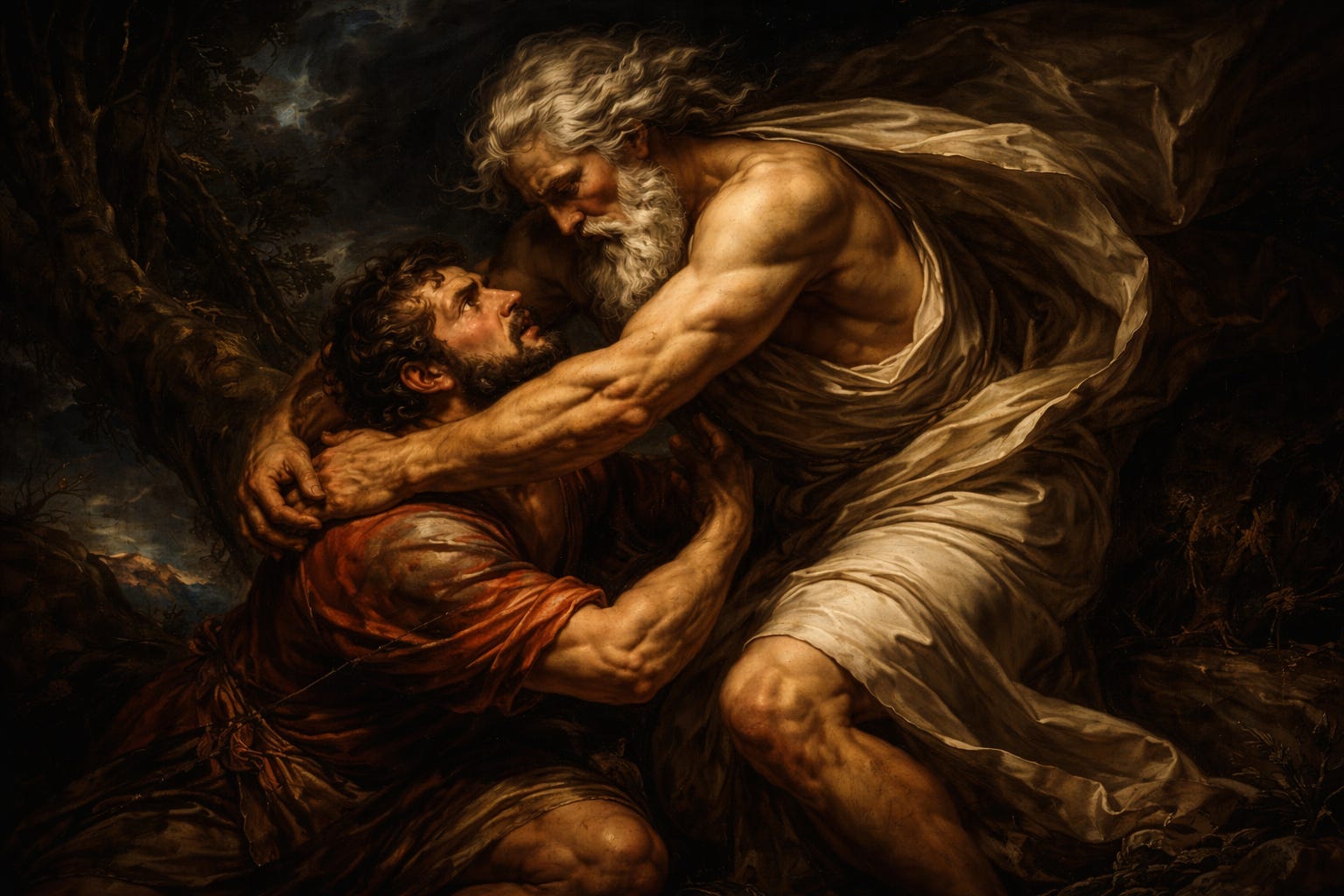
Jacob wrestles all night with a “man,” and realizes he has been with God face to face. God came close enough to grapple with. Close enough to be resisted. And close enough to bless us.
If we don’t get this, it is because we don’t get what “blessing” is. Blessing is not a commodity God tosses our way from a distance. It is not a payout. Blessing is always God giving Himself. Giving His presence. Giving His promise. Giving His future. There is no greater blessing possible than communion with God. This is the very thing for which we were made. This is life itself. God’s blessing always leads us into communion with Him. It is never anything else. Never.
It is not good health, a better financial position, a more dependable automobile, a parking spot up front, and most of the things we ask Him to bless us with. If God’s goal was just to give Jacob perks, He could have done it from afar. But covenant blessing—God’s only kind of blessing—is God binding Jacob to Himself in his most broken places, so real communion can happen. Blessing is communion, and communion requires presence, not distance. God’s presence exposes what distance lets us hide.
God comes close enough to wrestle with us because of what it is He is healing; God is healing our will, not merely correcting our behavior. Jacob’s real problem isn’t a few bad choices he made, for which a little commodity called “grace” would be sufficient.
Jacob’s deepest problem, like our own, is autonomy. I will secure my own life. I will manufacture my blessing. I will make sure I do not lose. I will manage the outcome. I will become who I want to be. I will name myself. I will shape who I am. I will protect myself from disappointment. I will make sure the story ends the way I need it to. I will not be weak. I will hold on to the life I have built. I will not let go.
Autonomy is the fundamental human sin that started in the garden. It is the claim that we can live apart from communion with God, the source of all life. Every step toward autonomy, then, by definition, is a step back toward the nothingness out of which we were created. To heal this, God does not hand Jacob a lesson. God meets Jacob’s will as it actually is—striving, grasping, resisting—and wrestles with it until it is re-formed—until Jacob is drawn out of autonomy and back toward communion.
God could have crushed Jacob in an instant. But God desires communion, not coercion. Coercion is not blessing. If God simply overpowered Jacob, there would be no recognition, surrender, or trust—just defeat. The struggle itself is mercy, because God comes close enough to be resisted without destroying the one who resists. God relates to Jacob not as an enemy to be eliminated, but as a covenant partner to be transformed. That is the difference between domination and transformation.
God truly draws near to Jacob, not through some abstract theological declaration of who He is, and not as advice, but as personal presence. He comes in a way Jacob can bear. He draws near in accommodated form. He does not cease to be God, but He relates to Jacob in a way Jacob can actually endure. God lets Jacob’s resistance surface, lets him strive, cling, expose himself, and finally be renamed. God’s nearness didn’t erase Jacob; it created space for him to be unmasked and transformed.
When something is hidden, it can’t be healed. So Jacob’s resistance is dragged into the light. In wrestling, his lifelong posture emerges: striving, bargaining, clinging. The turning point is not Jacob’s victory, but the transformation of his grasp. He stops scheming for blessing and starts pleading for it. “I will not let you go unless you bless me” is Jacob finally meeting God as God, not as a system to manipulate. It is the acknowledgment that blessing comes from God alone and that blessing is communion with Him.
And then Jacob receives a new name, but only after he is unmasked. The story hinges on Jacob’s identity: “What is your name?” “Jacob (the supplanter, the overreacher, the schemer).” All the wrestling results in Jacob telling the truth about who he is; he speaks his own name, and then he is re-named. He isn’t renamed while hiding behind his old self. The order matters. We cannot self-identify our way into communion. Every step toward autonomy leads us away.
God comes close enough to us to bless us, and for Jacob, that closeness means struggle. It’s a real wrestling match. It’s not a technique; it’s what grace feels like when it collides with our autonomy and refuses to let us slip into nothingness. God stays in the struggle to the end so that Jacob can learn who he is dealing with and what kind of man he really is.
God does what grace always does. He wrestles us. He blesses us. He transforms us. He renames us. That’s what transformation is. It’s not annihilation; it’s communion.
The only honest response.
Here I am!
So what does any of this mean on an ordinary Sunday with ordinary people gathered to worship? It means that our most honest response is not a spiritual performance. It is simply this: Here I am. Not “Here I am, cleaned up.” Not “Here I am, finally stable.” Not “Here I am, worthy.” Just: Here I am.
With that simple “Here I am,” we can finally ask for what grace truly offers: Meet me in the truth of who I am. Wrestle down what is false in me. Heal what is wounded. Free me from my need to control everything.
Our relentless urge to control is just unbelief disguised as competence. Control is autonomy on parade. Jacob shows how exhausting this scramble for blessing, security, and identity can be—until God interrupts it with Himself.
This is why, when we gather on Sunday, worship is not for the spiritually strong. It is for the held. We gather not because we are strong, but because God is faithful. Not because we have held on, but because He has not let go. His faithfulness is not an abstract idea. It is the living Triune God—Father, Son, and Holy Spirit—moving toward Jacob-people with relentless grace, holding us through death, turning our dysfunctional stories into communion and blessing.
This is God’s unrelenting grip.
And Jacob was left alone. And a man wrestled with him until the breaking of the day. When the man saw that he did not prevail against Jacob, he touched his hip socket, and Jacob's hip was put out of joint as he wrestled with him. Then he said, “Let me go, for the day has broken.” But Jacob said, “I will not let you go unless you bless me.” And he said to him, “What is your name?” And he said, “Jacob.” Then he said, “Your name shall no longer be called Jacob, but Israel,[a] for you have striven with God and with men, and have prevailed.” Then Jacob asked him, “Please tell me your name.” But he said, “Why is it that you ask my name?” And there he blessed him. So Jacob called the name of the place Peniel, saying, “For I have seen God face to face, and yet my life has been delivered.”
— Genesis 32:24–30

And the Word became flesh and dwelt among us.
— John 1:14

And as for the resurrection of the dead, have you not read what was said to you by God: ‘I am the God of Abraham, and the God of Isaac, and the God of Jacob’? He is not God of the dead, but of the living.”
— Matthew 22:31-32

For I am sure that neither death nor life, nor angels nor rulers, nor things present nor things to come, nor powers, nor height nor depth, nor anything else in all creation, will be able to separate us from the love of God in Christ Jesus our Lord.
— Romans 8:38-39

He always lives to make intercession for them.
— Hebrews 7:25
This spiritual antipasto has an accompanying call to worship.
Fierce grace.

God is the God of “that Jacob,” and that’s the point. The God revealed in Scripture is not embarrassed by the patriarchs. God binds Himself to the deceiving, selfish, relationship-destroying Jacob, which means no reader gets to assume they are “too much” for Him.